October 2024

Anora

Y’know when you start tearing up because a film is just so, so satisfying to watch?
With a turbulent cinematic whirlwind of Tangerine, The Florida Project and Red Rocket forming his filmography, director Sean Baker, I believe, has become modern moviemaking’s defining face of neorealist storytelling – and Anora definitively seems like a triumphant amalgam of his entire career: A magnum opus.
This is Baker at his grandest, hugest and most epic yet: it’s a sprawling, scrambling saga of betrayal, heart-break, chaos and a filth-filled SYMPHONY of swearing. Taking a pinch of the Coens and a dash of the Safdies, the film orchestrates a gut-bustlingly funny generational skirmish: the reckless, libidinous youth brawl with the bumbling, constantly befuddled adults in a balletic jumble of darkly hilarious mishaps.
However, with the emotional volatility of the cast times 5 billion, what unfolds is Baker’s true directorial prowess of an almighty, almost uncomfortable sense of human tangibility. Abrasively evident within his previous projects, there's a fearlessness here of displaying such sincere vulnerability and ugly flaws amongst the harsh, real-world grit, contrasting to an even greater sense of non-judgemental benevolence for these characters, that is so delicately, yet staggeringly realised. Ani’s childish naivety and sex worker persona is portrayed with such profound warmth, accentuating a new level of depth to the central theme of dualities – It’s the light and the dark: The glitz and the pain, and an adolescent fantasy clashing with a brutal, cold reality.
Just an absolutely outstanding piece of work. If you only see one film this year (first of all, what are you doing?!) see Anora.
The Wild Robot

It’s funny how I’m more excited about DreamWorks and Sony projects than I am Pixar as of late. Riding the coattails of the stellar Puss In Boots: The Last Wish and arriving with an uproarious lathering of praise, my expectations were high for The Wild Robot, and whilst I enjoyed it, I couldn’t help but feel left in a state of automatous disappointment.
Although, glimmers of what the film truly aspires to I found to be greatly admirable: the initial ambient, silent-cinema inspired escapades of Lupita Nyong’o’s titular philanthropic 'Roz' I found to be quietly charming, as they adapt to their newfound maternity within this visual stunning, painterly landscape, with surprisingly welcome bursts of morbid humour throughout – it reminded me just how brilliantly handled director Chris Sanders’ previous efforts were, specifically Lilo and Stitch and How to Train Your Dragon.
However for me, the failing of The Wild Robot is that it can’t seem to sit with that placidity; it possesses this strange need to fulfil a generic ‘kids film’ quota with a rapid, frantic pace to entice younger viewers, lacking a desperately needed confident, mature patience at the cowardice of potentially straining attention-spans. The scene-to-scene flow of the narrative honestly borders on brain-rot, oddly antithetical to its pastoral setting. This furthermore extends to the plethora of woodland critters, all of them proving blandly unremarkable: with the unsuspecting randomness of death as a central theme (and gag), character demises are fleeting, and therefore render the cute and cuddly cohorts as meaninglessly disposable.
I felt that there was this shackle of mainstream appeasement restricting something genuinely special. An interesting animated picture confined to the mechanical, robotic shell of a serviceable one.
Look Back

I have a confession: I don’t really like Whisper of the Heart that much. There’s something about the tweenie, YA novel schmaltz that I just find mawkishly irksome. However, I’ve now seen Look Back, based on a manga I had never even heard of, exploring a similar subject of the artistic process connecting two aspiring creatives. And whilst the sickly sweetness of the former left me wincing, Look Back won me over: the difference being an audacious array of complete, woeful devastation – I was moved, and yes, I cried.
The film’s compelling soulfulness lies in the conundrum of why we create: art is hailed as the great healer, a tool for communication and an optimistic ointment for bridging intimacies; the visual and thematic signifier of division between the two leading mangakas is slowly demolished through this shared enrichment of creative practice. And whilst it sometimes teeters into saccharine or the ‘friends we made along the way’ platitude, it counteracts that with the aforementioned vicious, guttural stab of emotional impact. The final moments of Look Back are genuinely distressing, but writer/director Kiyotaka Oshiyama manages to spin that turmoil into a bittersweet final note of finding the good in what happened, rather than the ache of what could have been. And sometimes it was simply the power of four tiny drawings.
In the current cartoon climate of droids versus dip pens, Look Back rules as this month’s superior animated tear-jerker for me.
Shin-Chan: The Adult Empire Strikes Back (2001)
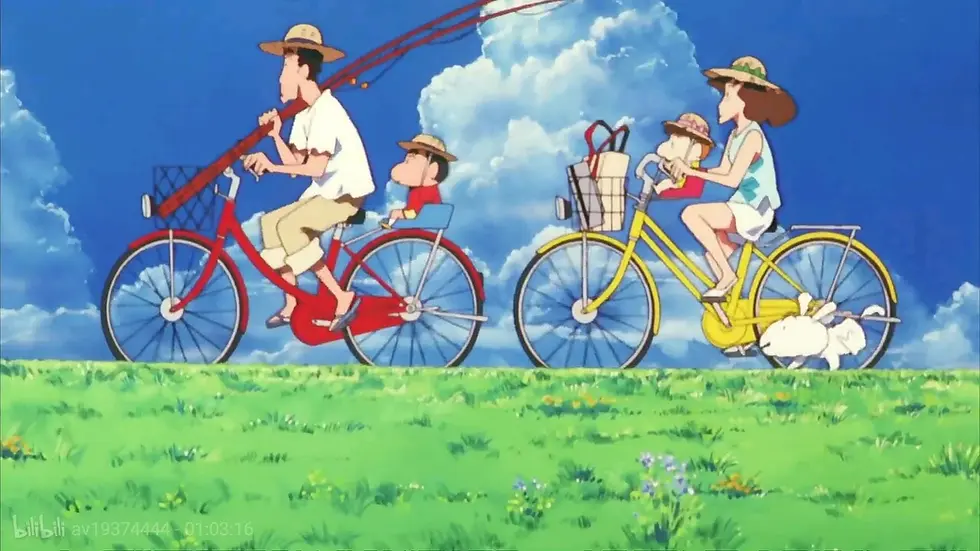
It’s no secret that nostalgia has become increasingly poisonous within the cinematic landscape. It’s the seductress that inhibits the new, preferring the attractive allure of the familiar and comforting: it’s enticing to look back, and frightening to tackle the unknown. I don’t think I’ve seen this notion explored better than in Shin-Chan: The Adult Empire Strikes Back, an unforeseen revelation that abruptly emerges from a veneer of butt and fart jokes, shifting this boyish romp into something rather exceptional.
With being wary around spoilers, The Adult Empire begins as standard peppy fare – a moderately rambunctious offering of NickToons-inspired slapstick and pratfalls, wrapped up in a sprightly, kiddish jaunt to ‘save the parents’. But then, the turning point occurs: a completely wordless montage had by one of the characters. A silent, three-minute séance of self-reflection, as they’re led out of that nostalgic comfort and forced to reconcile with their ever-slipping present: this scene stupefied me. I was in this trance-like daze on par with, actually no fuck it, ABOVE Up’s ‘married life’ sequence.
I was totally unfamiliar with Shin-Chan as a franchise before this, but amongst the misadventures of an ass-flashing rascal is the last place I’d expect to find such a mesmeric hidden gem of filmmaking.