February 2025

Updated: Jul 31, 2025
Hard Truths
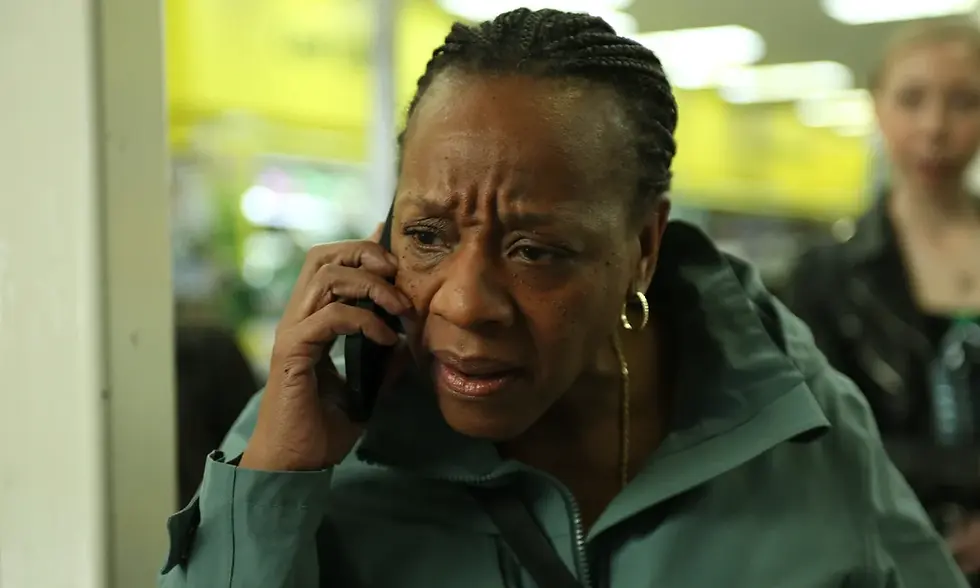
Mike Leigh’s Hard Truths is a film about suppression and honesty. You get the sense that its subjects are putting up a front or concealment - Kayla (Ani Nelson) lies about an earful she receives at work, Curtley (David Webber) remains silent when asked about his mother and Tuwaine Barret’s Moses is close to non-verbal. And then there's Pansy (Marianne Jean-Baptiste). A personified vessel of misanthropic bitterness, she says what we sometimes truly want to say. Like an unfiltered harbinger of those back-of-the-mind intrusive thoughts that should probably remain unspoken, Pansy says them. They’re a character at home in the typical ‘Leigh-lineage’ of David Thewlis’ motormouth Johnny or Sally Hawkins’ relentlessly sunny Poppy - oftentimes riotously funny, sometimes vexing, but above all, rife with emotional depth: Pansy is a terrifically executed manifestation of a collapsing person in a collapsing world: a cry for help.
Hard Truths is very much a post-pandemic movie, maybe the best of its kind. With our volatile anti-heroine emerging from ‘the new normal’, carrying the weight of bereavement, trauma and subtly coded depression and agoraphobia, the only natural verbalisation would be one of screaming rage. She’s forgotten how to live - illustrated by the simplest action of when she tries to display some flowers, before storming out the room; in addition to a brutally confrontational breakdown, beginning with laughter and ending in sobbing. That sense of a frustrating emotional purgatory is beautifully executed by Leigh and his cast, as their different methods of communication and coping collide, yet sadly, rarely connect or are comprehended. This leads to the final scene, an almost trial-like judgement for Pansy, as she’s confronted with the opportunity to care for someone close to her, finally taking control of her life. It ends on a sledgehammer of an ambiguous note, with not only the characters, but the viewers themselves presented with the choice of leaving the confines of a cinema, and continuing to live.
Another absolute triumph for Mike Leigh, and up there with Anora and Memoir of a Snail as my trifecta of top films from 2024.
Cloud

I feel very few directors can pluck the nerve of underlying, invisible paranoias quite like Kiyoshi Kurosawa - I can’t never now pick up a knife and not feel a slight, shuddering twinge, inflicted by a gingerly first-time watch of Cure last year; a film that slyly whispers “Yes, you could just KILL someone right now!” It’s the pervasive, yet tacit human instincts and phenomena that Kurosawa scrupulously lacerates through his films, and his newest, Cloud, is no exception: this time, he’s got the Tate-ified tech-bros in his crosshairs!
Playing like an updated rebuild of his cyber-horror Pulse, Kurosawa taps into a more contemporary translation in the form of ‘keyboard-warrior’ culture: the smug, cowardly luxury of anonymity is a godsend to the incelular hivemind, a mask-like musk (hehe) to barf-out their beloved ‘free-speech’ (aka Racism). Cloud escalates that notion to the most extreme of heights with the ravenous ‘cancelling’ of our scummy, but innocuous protagonist Yoshii - a reseller with the same inherent toxicity as the online swarm. Everyone is painted as an anti-hero, as the film questions the potential of online death-threats and ‘arm-chair’ attacks, evolving into the machismo power-fantasy of still evasive, yet vengeful murder. The satire is scabrous and anarchically entertaining, beginning as sinister and implicit - classically Kurosawa, but then opting for a Parasite style second-act tonal shift: maybe not so much a deviation, but a careening hard-left (or more appropriately hard-right). Cloud’s last hour trades out the cerebral for sidearms, where some of the film's most head-scrambling, batshit moments occur. This unexpected dive does equate to a great deal of fun, although simultaneously a pinch of disappointment, betraying not only the previously established tone, but the expected, methodical house-style of Kurosawa as a director.
Whilst Cloud is a film I very much enjoyed, be wary that it is a diversion from the rest of his filmography, perhaps inaccessible to both longtime fans and wide-eyed newcomers. For me however, it’s an action-movie only Kurosawa could concoct. It does go off the rails, but in a good way.
Dog Man

I’m not sure if I’ve ever explicitly mentioned this, but I am a HUGE fan of Dav Pilkey. One of the main catalysts that spurred my introduction to reading, the anti-authoritarian power of creativity hailed in his Captain Underpants series was a fundamental precursor for my own cartooning career. Now as an adult and revisiting his works, I’m endlessly inspired by Pilkey’s brilliant ability to warmly understand and empathise with the perspective of a child; for within his lavatorial and scatological menagerie, there isn’t a hint of condescension towards his young audience. With Pilkey himself being a neurodivergent artist, his stories celebrate the outsiders - and very few come close to the sincere realisation to that of George Beard and Harold Hutchins, his two self-inserts: watching Dog Man is like entering the hyperactive minds of the artful fourth-graders. It’s a film that feels like it was made by children, and I mean that in the least derogatory way.
Like a crayon-covered, sugar-powered sketchbook page come to life, the visuals of Dog Man are its crowning achievement: the candy-coloured onomatopoeia, choppy frame rate and hand-crafted, doodle aesthetic exudes an almost stop-motion-esque sense of playful, childlike tactility, resulting in one of the most downright beautiful films DreamWorks has ever put out. However, this madcap visual approach also extends the film’s unapologetically slapdash structure: what was a detriment to The Wild Robot, feels like an asset to Dog Man - with the plotting and imagery complimenting each other, abiding by the golden ethos of ‘made by kids’.
Although much like a fridge-displayed, primary-school art project, there is that inner parental voice inside me that admits, yes, this is absolute nonsense. Whilst Dog Man’s freneticism is inescapable from a certain lack of depth or lasting, introspective memorability, the passionate spirit of Pilkey is very much prevalent, and similar to his literary efforts, comes from a deeply autobiographical place: you know a film revels in its own chaotic energy and a neurodivergent joy, when one of the characters is literally called ‘80-HD’.